We're Finally Unlocking the "Cosmic Shoreline"
Astronomer David Kipping discusses the cosmic shoreline: the connection between a planet’s gravity, stellar irradiation and ability to retain an atmosphere.
Source Cool Worlds
An animated thought experiment compares tiny black holes by their mass and size. This is an imaginative explainer, not a proposal to create one.
Source Kurzgesagt – In a Nutshell
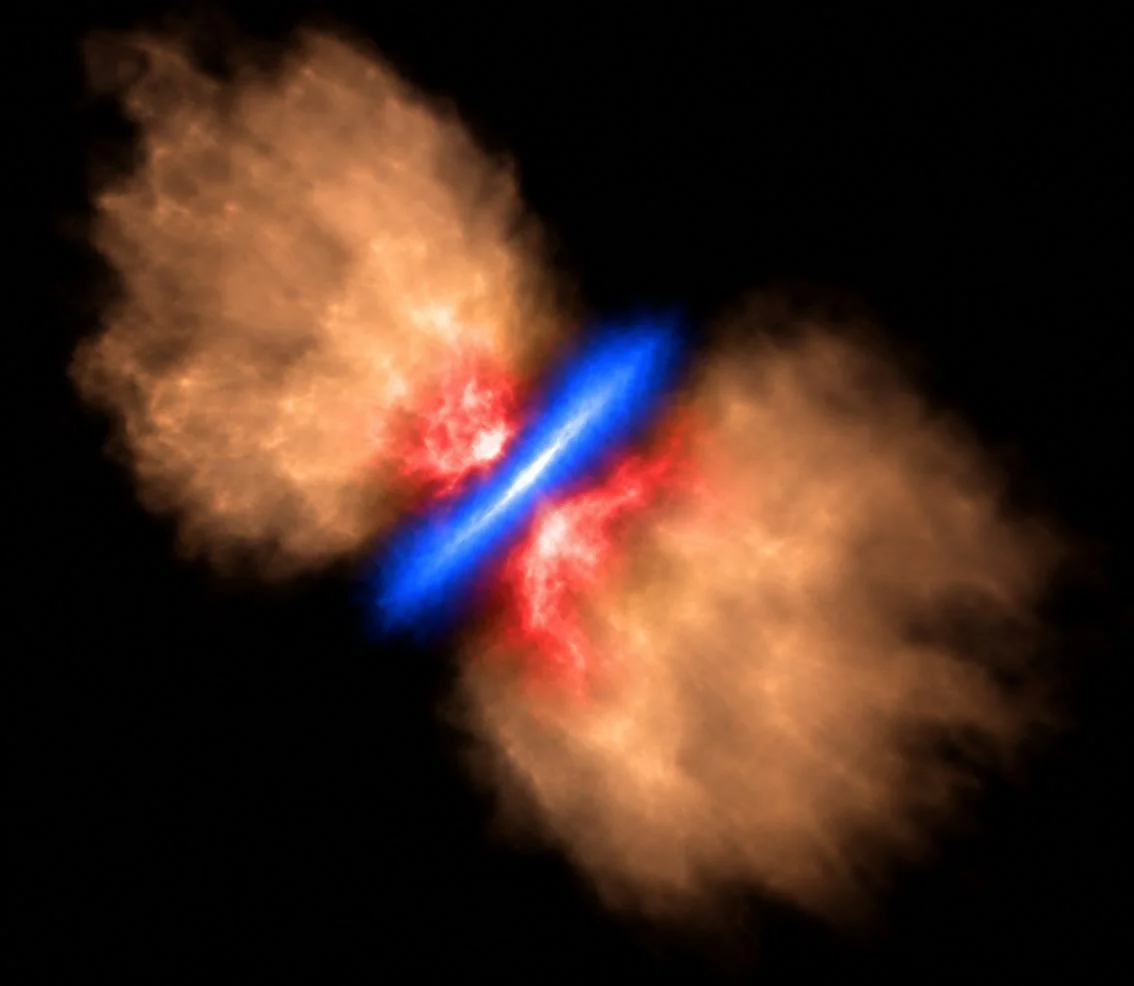
ALMA detected three titanium-monoxide emission lines around Orion Source I, a massive forming star. The gas lies near the base of a rotating disk wind. Researchers interpret it as titanium released from heated dust grains, offering a way to test high-temperature mineral processing rather than directly observing solid grains evaporate.
Source ALMA Observatory · Stellar chemistry · Research release · Image RIKEN (resized)
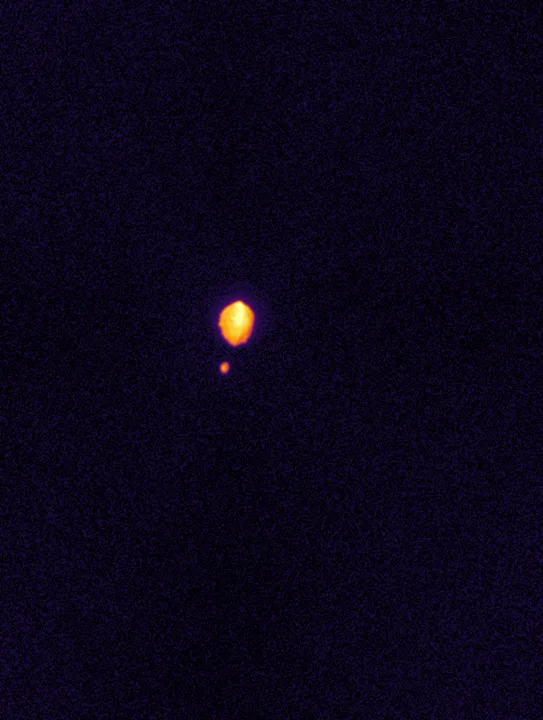
JAXA’s instrument detected a drop in thermal brightness as the asteroid moonlet moved into the shadow of Didymos.
Source JAXA · First thermal images from Hera · Image ESA/JAXA (resized)
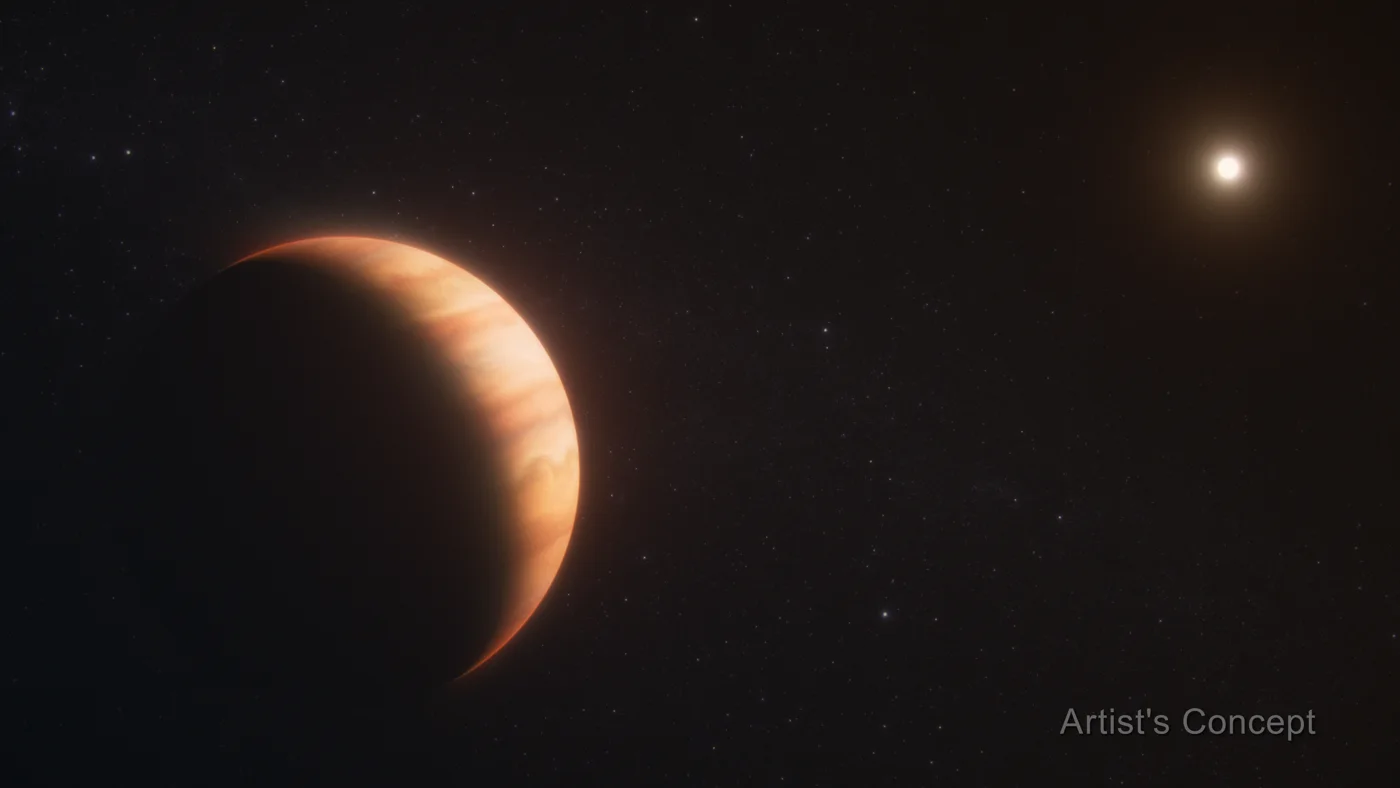
Webb detected atmospheric features and measured unexpected warmth from WD 1856 b, a giant planet orbiting a white dwarf. Cooling models favor migration inward billions of years after the star died. The observation helps distinguish survival on a distant orbit from enduring the star’s red-giant envelope.
Source ESA/Webb · Research release · Image NASA, ESA, CSA, R. Crawford (STScI) (resized)
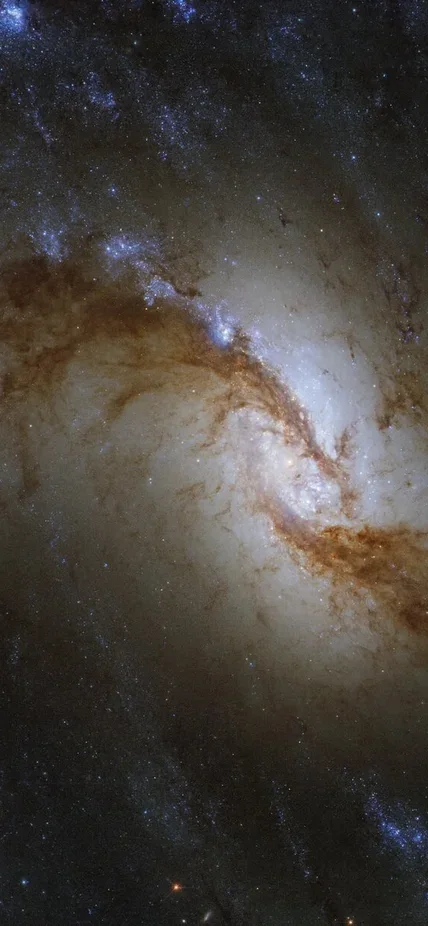
Astronomers used spatially resolved spectra to trace the chemical history of NGC 1365. TYPHOON survey observations separate individual star-forming clouds, letting researchers compare element patterns across the galaxy. The reconstruction tests how gas flows, star formation and mergers shaped a galaxy beyond our Milky Way.
Source Carnegie Science · Research release · Image ESA/Hubble & NASA, J. Lee and the PHANGS-HST Team; Acknowledgement: Judy Schmidt (Geckzilla) (resized)
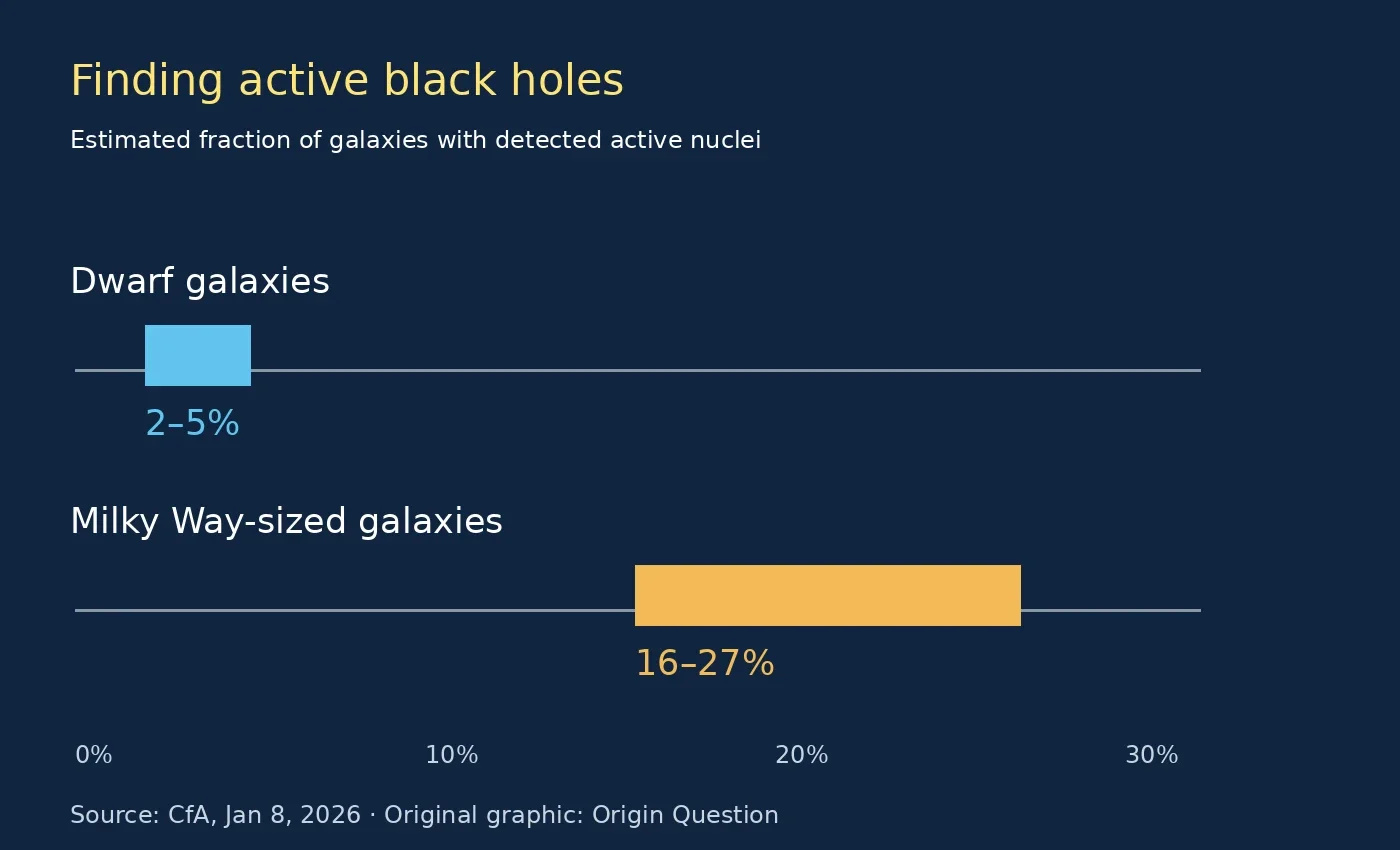
Researchers reassessed more than 8,000 nearby galaxies using optical and infrared measurements. Their census identifies active black holes in roughly 2–5% of dwarf galaxies, more than earlier surveys, with a sharp rise at Milky Way-like masses. Activity is not the same as black-hole presence; quiet objects and obscured signals remain difficult to count.
Source Center for Astrophysics · Original research release · Image Origin Question graphic using Polimera et al. census reported by CfA
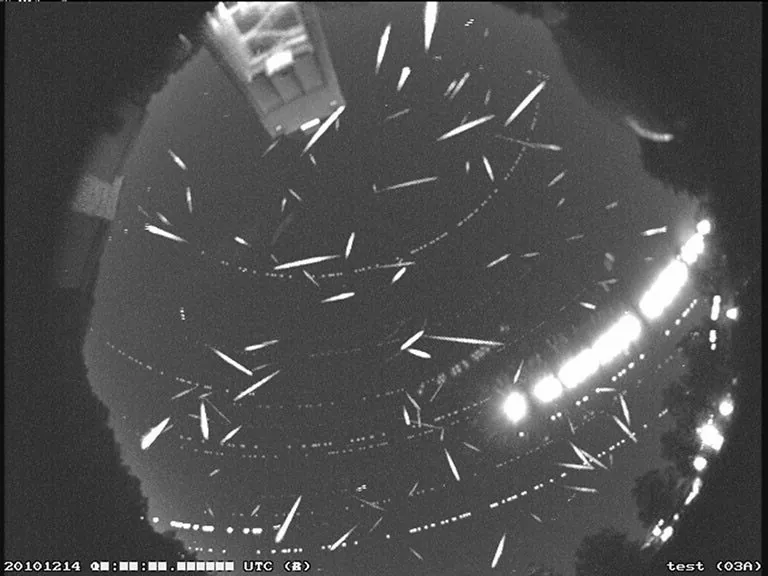
The 2026 Geminid meteor shower peaks December 13–14. For the continental U.S., start looking after 9 or 10 p.m. local time on Sunday and stay out later if skies are clear.
Source NASA · 2026 Geminids dates, expected rates and viewing tips · Image NASA/MSFC/Danielle Moser, NASA’s Meteoroid Environment Office (resized)
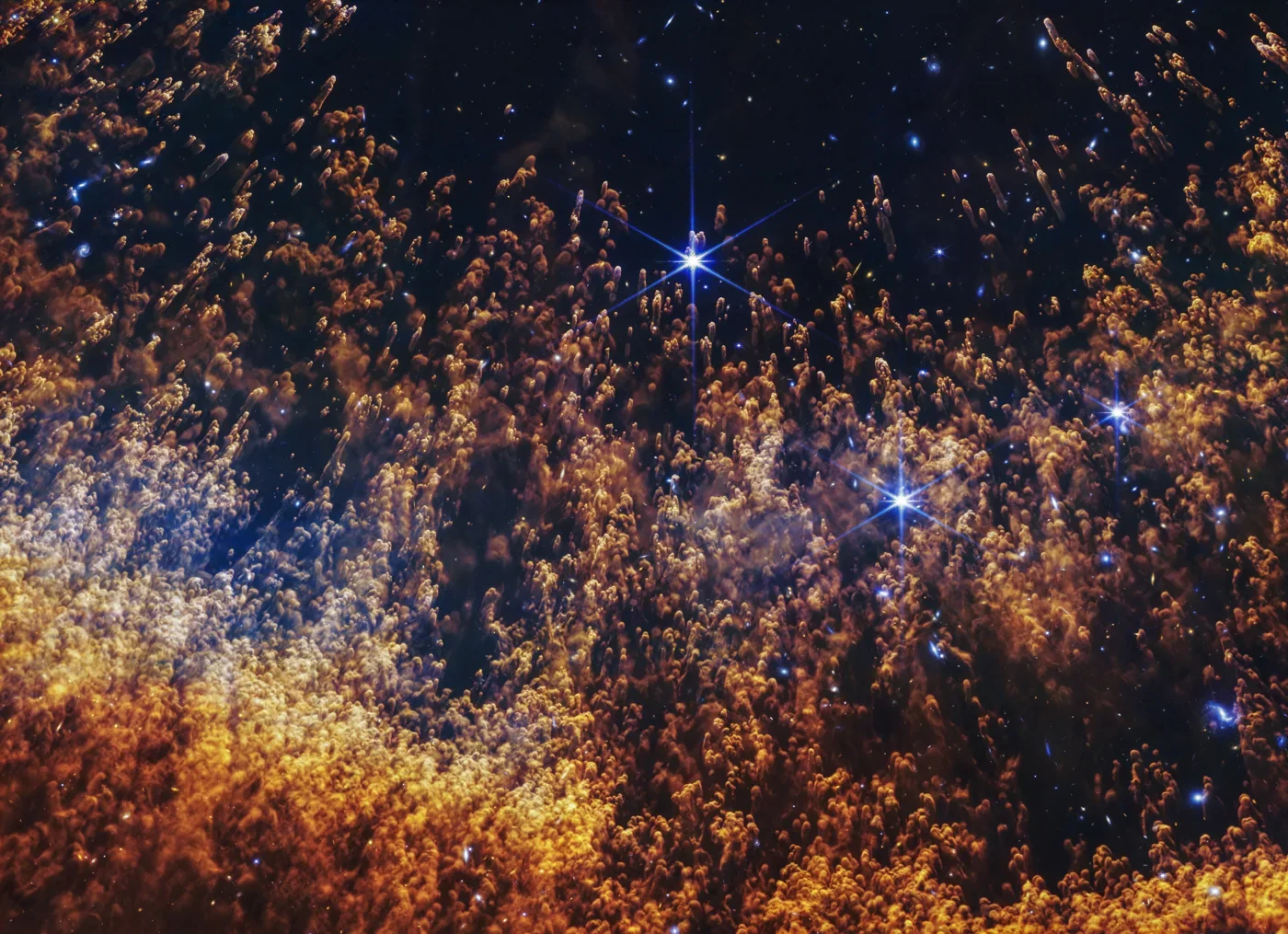
Webb’s close view of the Helix Nebula resolves comet-like knots where stellar winds meet previously ejected gas. Different infrared colors trace hot ionized material, molecular hydrogen and cooler dusty regions. The image shows how a dying star’s outflow becomes material available to later stellar generations.
Source ESA/Webb · Research release · Image NASA, ESA, CSA, STScI, A. Pagan (STScI) (resized)
Astrophysicist Becky Smethurst explores how supermassive black holes grow to the enormous masses measured in galaxy centres.
Source Dr. Becky
Loading the NASA Exoplanet Archive…
Loading today’s planet from the NASA Exoplanet Archive…
TRAPPIST-1 e and TOI-700 d receive amounts of starlight compatible with some habitable-zone models. Surface conditions, atmospheres and the presence of life remain open questions.
Follow topics and see when articles were added. Choices stay in this browser.
Source Veritasium
Derek Muller explains the appearance of black holes and how their gravity bends the light reaching an observer.
Source ESA · Hera’s first close-up findings · Image ESA / Hera Asteroid Framing Camera
ESA’s first close views show a stadium-sized crater across one face of the asteroid moonlet. Dimorphos is also tumbling as it orbits Didymos.
Source Southwest Research Institute · Original research release · Image NASA/Johns Hopkins APL/SwRI (resized)
A new analysis of New Horizons images links dark features on northern Sputnik Planitia to possible liquid nitrogen. Models show that ice beneath the glacier could melt and rise through conduits. The observations support recent wetting, rather than directly recording flowing liquid; laboratory tests and better mapping could test the interpretation.
Source Chandra X-ray Center · Research release · Image NASA/CXC/Univ. Milano-Bicocca/W. Wang et al. (resized)
A distant galaxy has plenty of surrounding gas but surprisingly little new star formation. Chandra reveals a neighboring black hole’s jet aimed toward that gas. The team proposes that the jet stirs the reservoir, preventing material from settling into the galaxy and making stars.
Source ALMA Observatory · Original research release · Image Takashi Shimonishi (Niigata University), based on observation results, with illustration support from generative AI (resized)
ALMA detected two warm molecular cocoons around newborn stars inside RX J1713.7−3946, the remains of a stellar explosion. Both contain organic molecules; one resembles ordinary stellar nurseries chemically. The result suggests that complex chemistry can persist nearby, but the degree of shielding and whether this survival is common remain open.
Source ESO · Research release · Image ESO/C. Lawlor, R. F. van Capelleveen et al. (resized)
VLT images and interferometry confirm a second gas giant inside the rings of WISPIT 2. The young system offers a rare view of two planets forming together. A more distant gap could hide another planet, but that possibility still needs a direct detection.
Source MinutePhysics
A musical rewrite turns a nursery rhyme into a short astronomy lesson.
Source Sixty Symbols
University of Nottingham scientists explain what stellar classifications such as the Sun’s G2V designation tell us.
Source W. M. Keck Observatory · Sodium observations · Image NASA/JPL
Keck observations show that the faint sodium cloud around Europa stayed relatively stable despite changes in neighboring Io’s volcanic activity. Measuring the glow while Europa was in Jupiter’s shadow made the cloud easier to see near the surface. The team argues that sodium released from salty ice on Europa is the best fit to the data.
Source NASA Science · Study overview · Image NASA, ESA and G. Bacon (STScI)
NASA researchers measured oxygen in tiny particles collected high in Earth’s atmosphere and examined whether dust from the Kuiper Belt carried unusually heavy oxygen isotopes. The results support a long-lived reservoir of ice in the young Solar System and offer a way to trace how water-bearing material moved.
Source European Southern Observatory · Data release · Image ESO/H. Zodet
ESO released spectra from the CORALIE radial-velocity survey at La Silla. The archive combines observations from three versions of the spectrograph up to 2024. Anyone reanalyzing small stellar wobbles needs to account for the instrument changes that shifted the velocity baseline.
Source Chandra X-ray Center · Observations · Image X-ray: NASA/CXC/McGill Univ./M. Balakrishnan et al.; Radio: NSF/NRAO/VLA; Sub-mm: EAO/JCMT; Processing: NASA/CXC/SAO/P. Edmonds, N. Wolk
Combining 35 Chandra observations, researchers filtered out overlapping X-ray signals to isolate the Sagittarius A East supernova remnant. They mapped several elements inside it. The maps support the idea that the remnant helped heat and stir nearby gas and give astronomers a way to investigate the star that exploded.
Source The Royal Institution
Particle physicist Kate Shaw traces how the Standard Model was tested and explains how the top quark’s mass bears on the still-open question of vacuum stability.
Source NASA Goddard
This mission concept shows how a future observatory could separate a planet’s light from its star and look for patterns in the planet’s atmosphere.
Source Max Planck Institute for Solar System Research · Arrival at Mercury · Image ESA. Acknowledgement: ATG Europe (resized animation still)
The European-Japanese BepiColombo stack reached orbit around Mercury even though its insertion burn ended early, leaving it farther from the planet than planned. The stack still carries two orbiters. Once they separate, they will study Mercury’s interior, surface and magnetic surroundings from different orbits.
Source Chandra X-ray Center · Sonification and observations · Image NASA/CXC/SAO
The Chandra X-ray Center translated telescope data from M82 and three other objects into sound. In M82, rapid star formation helps drive a flow of hot gas that Chandra sees in X-rays. The sonification gives listeners another way to explore the structure of the data.
Source Physical Review Letters · Search and limits · Image Origin Question illustration based on the pulsar timing method
Researchers accounted for cosmic redshift when searching Parkes pulsar timing data for quiet, persistent gravitational waves. In targeted searches toward two early-universe objects, they ruled out certain binary black holes with chirp masses above roughly ten billion Suns in the frequencies they tested. The result sets limits on how massive a pair could be without producing a detectable signal.
Source NASA Science · Roman commissioning · Image NASA
NASA says Roman can point, guide and take exposures after its initial instrument checks. In the final commissioning stage the team will test how those systems work together for science. Its wide surveys will trace changes in the distribution of galaxies and investigate how the universe expanded.
Source Fermilab
Particle physicist Don Lincoln explains why most neutrinos pass through ordinary matter and how large detectors record the rare interactions.
Source SciShow
Hank Green explains what makes a ring system and why Saturn is the easiest planet on which to see one. The video is an introductory explainer from 2014.
Source NASA Science · Observing program · Image NASA, ESA, and S. Terry (University of Maryland); Image Processing: G. Kober (NASA/Catholic University of America) (resized)
Hubble resolved about 180,000 stars in crowded fields near the Milky Way’s center. Roman will return to this region and look for temporary brightening caused when foreground stars or planets bend background starlight. The Hubble data give astronomers a baseline for comparing the two telescopes’ measurements.
Source Canada-France-Hawaiʻi Telescope · Discovery release · Image Pan-STARRS1/STScI/MAST (left); International Gemini Observatory/NSF NOIRLab (right). Graphic by Étienne Artigau and Heidi White (UdeM) (resized)
Astronomers looking for planets instead uncovered a close white dwarf orbiting a red dwarf in Welopōʻai, about 28 light-years away. A second white dwarf lies much farther out. Measuring the masses of the close pair gives researchers a way to test how stars lose mass and how multi-star systems survive that process.
Source The JWST Sub-Jupiters Survey · Research preprint · Image Origin Question graphic using Ferrer-Chavez et al. data
The NASA Exoplanet Archive added RX J0534 b, a giant orbiting a young red dwarf. Webb first detected it in infrared. A follow-up at the Large Binocular Telescope showed the point moving with the star. At the time of observation, its projected separation was about 14 times the Earth–Sun distance. A second Webb image shows an extended debris disk.
Source ESO · Observatory announcement · Image Andrea Busatta / INAF and CTAO. Background: CyD Ingeniería. (resized)
Two large telescopes will join the southern site of the Cherenkov Telescope Array Observatory. Their mirrors gather the faint flashes created when gamma rays hit the atmosphere. This extends the Chilean site’s reach to lower gamma-ray energies and helps astronomers compare what they see over a broader part of the spectrum.
Source University of Tokyo · Spectroscopy and research summary · Image Origin Question graphic using University of Tokyo report data
Webb spectroscopy measured a redshift of 10.36 for CW-LRD-z10, placing it about 450 million years after the Big Bang. It is the most distant strong little red dot candidate with a spectroscopic redshift in the team’s report. The color and compact appearance make it a target for studying early black hole growth. The redshift fixes its place in cosmic history, while the nature of its light source remains uncertain.
Source The Royal Institution
Astrophysicist Emma Chapman explains how the first stars ionized surrounding hydrogen and how astronomers look for those changes in ancient light.
Source PBS Space Time
Matt O’Dowd explores why evidence for a hot, dense early universe leaves the question of an earlier phase open. The proposed scenarios are explicitly hypothetical.
Source NASA Science · Mission update · Image NASA/Johns Hopkins APL/Ed Whitman (resized)
Technicians installed and tested the seven cameras on NASA’s Titan rotorcraft. The forward cameras can measure depth from overlapping views, the downward cameras help the team evaluate sampling sites, and a microscope camera can inspect grains near the drill. The images will help relate collected material to its local terrain.
Source Max Planck Institute for Astronomy · Discovery report · Image ESA/Euclid/Euclid Consortium/NASA, Wolf et al. (resized)
The Euclid survey picked out J1504+6252, and follow-up spectroscopy measured a redshift of 8.13. We see the quasar about 630 million years after the Big Bang, when its central black hole already had an estimated mass of 360 million Suns. Models with massive starting seeds can explain this rapid growth, though the observations do not trace how this black hole formed.
Source ALMA Observatory · Research release · Image M. Liao et al. – ALMA (ESO/NAOJ/NRAO)/N. Lira (resized)
ALMA mapped gas near the center of the obscured quasar W2246-0526, seen when the universe was about 1.3 billion years old. Once the team modeled the outflow, increasingly fast gas near the center pointed to a black hole of roughly 6.5 billion solar masses. This offers a direct check on estimates that instead infer mass from the quasar’s light.
Source CERN
An interview with two LHCb physicists about why subtle differences between matter and antimatter are so important.
Source ESA/Webb · Image NASA, ESA, CSA, STScI, G. Villanueva, A. Pagan, L. Hustak
A visualization of the plume material feeding a ring-shaped cloud around Saturn.
Source CERN
BASE researchers move trapped antiprotons as a step toward more precise measurements.
Source NASA · Apophis facts · Image Origin Question illustration
A close, safe Earth flyby gives astronomers an opportunity to watch how gravity affects an asteroid.
Source NASA Science · Lucy’s flyby findings · Image NASA
Lucy’s close view of Donaldjohanson exposed a narrow neck and a shape that may preserve clues about how small bodies collide.
Source NASA · Bennu’s future orbit · Image NASA/Goddard/University of Arizona
Radio tracking from the mission constrained where Bennu will be when Earth’s gravity bends its path in 2135.
Source Origin Question
Explore anniversaries, mission milestones and the NASA historical archive.
Source Kurzgesagt – In a Nutshell
A colorful animated introduction to black holes: how collapsing stars can create them, what an event horizon means and how Hawking radiation could slowly evaporate them. This is an older explainer, including theoretical ideas.
Source Cool Worlds
Astronomer David Kipping separates different versions of the Fermi paradox and examines the assumptions behind alien-visitation arguments. His proposed explanation is a scientific discussion, not evidence that extraterrestrial life has been found.
Source Rubin Observatory discovery release · Image NSF–DOE Vera C. Rubin Observatory/NOIRLab/SLAC/AURA; Image Processing: M. Jurić (UW), D. de Martin & M. Zamani (NSF NOIRLab) (resized)
Rubin observations uncovered 2026 ED138, a distant object whose brightness suggests a diameter between 600 and 1,500 kilometers. Archival images extended its measured orbit back a decade. Its size depends on uncertain surface reflectivity, so infrared measurements are needed before researchers can confirm its dimensions and potential dwarf-planet status.
Source NASA JPL research release · Image NASA/JPL-Caltech/ASU/MSSS (resized)
Perseverance examined alternating fragmented rocks and pulverized material in the Broom Point formation on Jezero Crater’s rim. Abundant glassy beads and repeating layers point to multiple ancient impacts rather than one event. The sequence may predate Jezero itself, but precise ages would require laboratory dating of samples returned to Earth.
Source UCL research release · Image NASA, ESA, CSA, STScI, Justin Pierel (STScI), Andrew Newman (CIS) (resized)
Webb observations traced stellar motions in the gravitationally magnified galaxy MRG-M0138, revealing a dormant black hole with about six billion solar masses. The technique measures gravity’s effect on stars rather than bright accreting gas. Extending it to more distant galaxies could test how black holes and their hosts grew together.
Source University of Oxford research release · Image ESO/M. Kornmesser, L. Calçada (resized)
Measurements of seven hot gas giants revealed slower atmospheric winds on the hotter planets, contrary to a simple temperature-driven expectation. Researchers interpret the trend as magnetic fields braking charged atmospheric gas. The fields are inferred through models rather than directly imaged; a larger sample and improved calculations could test that explanation.
Source Veritasium
Derek Muller takes cosmic scale into the street, using questions and visual comparisons to explore the enormous differences between planets, stars, galaxies and the observable universe.
Source Dr. Becky
Astrophysicist Becky Smethurst examines measurements of cosmic geometry, explains what flatness means and discusses why intriguing hints need stronger evidence before changing the standard picture.
Source University of Warwick research release · Image NASA, ESA, L. Hustak (STScI) (resized)
Unusual heavy elements in the white dwarf HS 0209+0832 point to a candidate planet formed from material shed as its star died. Hubble spectra reveal abundant niobium, while TESS recorded a repeating brightness signal. The team proposes an evaporating gas giant; confirming this second-generation world will require further investigation.
Source Carnegie Science research release · Image ESO/spaceengine.org (resized)
Spectra from the Magellan Clay telescope revealed helium escaping from LHS 1140 b in 2024, with no corresponding signal in 2025. The changing escape provides evidence that this habitable-zone super-Earth retains an atmosphere. Researchers infer a helium-rich upper layer; the observations do not establish surface water or evidence of life.
Source Tohoku University research release · Image NASA/Goddard/University of Arizona (resized)
Researchers found six sugars, including ribose and glucose, in material returned from asteroid Bennu. Ribose forms part of RNA, while glucose supplies energy for many organisms on Earth. Their presence shows that relevant ingredients can occur beyond Earth; the analysis neither detects life nor determines how biology first emerged here.
Source ESA/Hubble · Observations and science context · Image ESA/Hubble & NASA, L. Galbany, S. Jha, K. Noll, A. Riess (resized)
SN 2012Z resembled a Type Ia supernova but was dimmer than a typical example. Hubble observations before and after the event support a partial explosion that left a surviving white dwarf. The host galaxy NGC 1309 also contained the more ordinary SN 2002fk, offering a striking comparison of different stellar explosions.
Source Fermilab
Physicist David Kaplan walks through the evidence for invisible matter and the experimental effort to detect it. Recorded in 2023, this public lecture connects cosmic structure with laboratory searches.
Source PBS Space Time
Matt O’Dowd explores gravitational lensing and the universe’s accelerating expansion, showing how astronomers investigate dark energy and why its behavior remains unsettled.
Source Southwest Research Institute research release · Image NASA (resized)
Models of Uranus and Neptune suggest inherited argon could overwhelm argon produced by radioactive decay inside the planets. Atmospheric isotope measurements might therefore reveal their formation environments more clearly than their rock content. The study predicts what future probes could test; it does not directly measure either planet’s deep interior.
Source NASA JPL research release · Image NASA/JPL-Caltech (resized)
Perseverance measured fine and ultrafine dust accumulating on calibration targets and spacesuit-material samples carried to Mars. Some particles remained attached through years of rover activity. Different materials collected different particle sizes, apparently influenced by static electricity. The findings could guide future equipment design, although actual astronaut exposures remain to be established.
Source ALMA · Research release · Image NSF/AUI/NSF NRAO/B. Saxton (resized)
ALMA traced a gas streamer extending about 12,000 astronomical units toward GW Orionis. Its motion closely matches the outermost of the triple-star system’s tilted dust rings, supporting infall as a cause of the disc’s unusual geometry. The remaining stream appears too weak to tilt the disc substantially further, so its earlier history matters.
Source ESA/Hubble · Observations and science context · Image ESA/Hubble & NASA, R. J. Foley (UC Santa Cruz) (resized)
Hubble observed SN 2023xqm in the spiral galaxy NGC 3285B as part of a programme targeting one hundred Type Ia supernovae. Measurements in ultraviolet, visible and near-infrared light help distinguish the reddening caused by dust from effects associated with distance, improving the calibration of these stellar explosions as cosmic distance markers.
Source The Royal Institution
The theoretical physicist discusses change, the present and the meaning of time in audience questions after his Royal Institution lecture. His interpretations of quantum gravity are distinguished from established relativistic effects.
Source NASA · Research release · Image NASA, ESA, CSA, STScI, Leah Hustak (STScI); Science: Viraj Karambelkar (Columbia) (resized)
Astronomers reconstructed the merger of a small star with a supergiant in Andromeda. Years of monitoring caught a slow brightening, dust formation and the 2025 eruption; Webb then observed the remnant. The analysis of AT 2025abao tests how a shared stellar envelope expels matter as two stars spiral together.
Source Carnegie Mellon University · Research announcement · Image NSF–DOE Vera C. Rubin Observatory/NOIRLab/SLAC/AURA (resized)
Einstein Probe caught an X-ray flash from SN 2026gzf, prompting observations across the electromagnetic spectrum. The explosion resembled supernovae associated with gamma-ray bursts, but Chandra and radio observations found no normal powerful jet. A jet stopped inside the star or surrounding gas is one proposed explanation, rather than a directly observed outcome.
Source ESO · Discovery and classification · Image ESO/M. Kornmesser (resized)
Radial-velocity measurements with ESO’s Very Large Telescope provide evidence for a Jupiter-mass-or-larger companion to the brown dwarf orbiting CD-35 2722. Its nested orbit would resemble a moon’s, while its mass resembles a planet’s. The candidate awaits confirmation, and even its classification challenges the usual divisions between moons, planets and brown dwarfs.
Source ESA/Hubble · Observation and research context · Image ESA/Hubble & NASA, M. Monelli; Acknowledgement: M. H. Özsaraç (resized)
Hubble resolved the crowded stars of NGC 1786 in the Large Magellanic Cloud. The observations belong to a programme comparing old clusters in nearby dwarf galaxies with those in the Milky Way. Testing for multiple stellar populations helps researchers judge how faithfully these long-lived clusters record a galaxy’s formation.
Source PBS Space Time
Matt O’Dowd examines why a universe with many possible habitats can still yield no confirmed extraterrestrial signal. The episode explores proposed explanations rather than evidence that any civilization has been found.
Source StarTalk
Tyson and Chuck Nice discuss how an astronomical perspective changes questions about life and mortality. This is a scientist-led conversation with philosophical reflections, not a numerical estimate of an afterlife.
Source NSF NOIRLab research release · Image International Gemini Observatory/NOIRLab/NSF/AURA/ALMA (ESO/NAOJ/NRAO); processing: T.A. Rector, D. de Martin and M. Zamani; acknowledgment: PI Yuji Urata (MITOS Science Co., LTD.) (resized)
Astronomers identified the dusty, star-forming galaxy nicknamed Shadow Blaster as a likely source of the high-energy neutrino IC 210922A. Gemini North and ALMA observations reveal distorted images produced by gravitational lensing. The proposed association supports a role for distant star-forming galaxies in neutrino production, while the event’s origin remains uncertain.
Source Chandra · Research release · Image X-ray: NASA/CXC/Penn State Univ./Z. Yu; Optical (HST): NASA/ESA/STScI; Infrared: NASA/ESA/CSA/STScI; Image Processing: NASA/CXC/SAO/P. Edmonds and L. Frattare (resized)
A study combining X-ray surveys of about 1.3 million galaxies and 8,000 growing black holes traced the decline since growth peaked roughly ten billion years ago. The analysis favors slower consumption of material as the main explanation. A dwindling supply of cold gas is a likely cause, rather than an established measurement of every galaxy’s fuel.
Source ESO · Survey release · Image ALMA(ESO/NAOJ/NRAO)/S. Longmore et al. Background: ESO/D. Minniti et al. (resized)
ALMA’s ACES survey mapped cold molecular gas across more than 650 light-years of the Galactic Centre, revealing an intricate network of filaments. It detected dozens of molecules, including complex organic compounds. The observations connect large gas structures with smaller stellar nurseries, helping researchers test how stars form in this unusually turbulent environment.
Source ESA/Hubble · Image and observing context · Image ESA/Hubble & NASA, D. Thilker (resized)
NGC 3507 presents its spiral arms almost face-on, while companion NGC 3501 is viewed nearly edge-on. Their contrasting appearances show why the angle from which we see a galaxy matters when interpreting its shape.
Source Fermilab
Don Lincoln separates what cosmology can test from conjectures about an earlier phase, explaining why the question remains unsettled.
Source Veritasium
An exploration of clock synchronization and the one-way speed of light. Round-trip light speed is measured; the episode explains the distinction.
Source Rutgers University research release · Image CTIO/NOIRLab/DOE/NSF/AURA; processing: T.A. Rector (University of Alaska Anchorage/NSF NOIRLab), M. Zamani and D. de Martin (NSF NOIRLab) (resized)
Astronomers mapped COSMOS-z3.1-A, a distant structure containing ten concentrations of galaxies that were developing into clusters. Follow-up distance measurements helped distinguish a connected structure from a chance alignment. Models suggest its components could grow into an exceptionally massive system, offering a test of how large cosmic structures assemble over time.
Source NASA JPL research release · Image Image data: NASA/JPL-Caltech/SwRI/MSSS; processing: Gerald Eichstädt (resized)
Juno measured temperatures rising beneath Io’s surface during two close flybys. The gradient is steeper than sunlight alone can explain. Heat moving through the crust and cooling lava buried beneath solidified material are possible explanations. The measurements also indicate broad smooth areas with unusually low-density material, resembling volcanic ash or pumice.
Source Paris Observatory research release · Image NASA/JPL/Space Science Institute (resized)
Webb spectra revealed an absorption feature near 5.11 micrometers on both Titan and Pluto. Comparisons with laboratory ice spectra have not identified its source. The researchers suggest an incompletely characterized compound or an ice mixture whose surroundings alter its spectrum. Further observations and laboratory experiments are needed to distinguish explanations.
Source ESA/Hubble · Observatory image and notes · Image ESA/Hubble & NASA, L. C. Ho, G. Brammer, A. Filippenko, C. Kilpatrick (resized)
Hubble’s visible-light image captures the dusty arms of a spiral galaxy and a bright, active region near its center. Observations at that scale help distinguish the stars in the central region from those farther out in the disk.
Source Perimeter Institute
Carlo Rovelli explores black-hole physics and discusses speculative ideas about white holes. Proposed quantum-gravity scenarios are not confirmed observations.
Source ESA/Webb · Image ESA, NASA, CSA, STScI, K. Pontoppidan, A. Pagan, N. Bartmann (resized)
ESA’s short film zooms in on Webb’s first-anniversary image and points out the structures around young stars.
Source ALMA · Research release · Image NASA, ESA, CSA, STScI, J. DePasquale (STScI), ALMA (ESO/NAOJ/NRAO), Y. Zhang (resized)
Nearly eight years of ALMA measurements reconstructed the motion of the young massive pair IRAS 07299−1651. A stretched orbit and sharply misaligned discs favor a close encounter between separately forming stars over birth in one disc. The observations leave open whether the pair will remain gravitationally bound as surrounding gas alters their motion.
Source University of Edinburgh research release · Image ESO/B. Sutlieff, M. Bonse et al. (resized)
Astronomers found Beta Pictoris d in new Very Large Telescope images, then recovered it in observations stretching back eleven years. The gas giant has about 2.4 times Jupiter’s mass. Its discovery gives researchers three planets in one nearby system to compare, helping test how giant worlds form and evolve.
Source ESO · Research release · Image ESO/K. Iłkiewicz and S. Scaringi et al. Background: PanSTARRS (resized)
Very Large Telescope observations mapped a bow shock around the white dwarf binary RXJ0528+2838. Its size suggests an outflow lasting at least a thousand years, although the system lacks the accretion disc usually associated with such flows. A magnetic field could supply energy, but the measured field does not yet explain the whole structure.
Source ESA/Hubble · Observatory image and notes · Image ESA/Hubble & NASA, F. Belfiore, J. Lee and the PHANGS-HST Team (resized)
Hubble shows a smooth center and a dusty outer ring with scattered young clusters. From our angle, some characteristics resemble a spiral and others do not, which makes the galaxy a useful test of classification.
Source NASA JPL research release · Image NASA/JPL-Caltech/MSSS (resized)
Perseverance found igneous rocks where scientists had expected lake sediments along Jezero Crater’s Margin Unit. Laser measurements indicate at least three episodes of interaction with water, each changing the minerals. The findings complicate the region’s history and help reconstruct past habitability; they do not establish that Mars once supported life.
Source Chandra · Research release · Image X-ray: NASA/CXC/Univ. of Alabama/M. Muhibullah et al.; Optical: NASA/ESA/STScI; Image Processing: NASA/CXC/SAO/N. Wolk (resized)
Searching Chandra observations of six galaxies, astronomers identified 84 sources dominated by very low-energy X-rays. They infer that these objects also emit substantial ultraviolet radiation. The sources may be compact stellar remnants drawing material from companion stars, but their identities and contribution to the radiation between galaxies remain unresolved.
Source ESA/Webb · Mission release · Image NASA, ESA, CSA, STScI, A. Simon (NASA-GSFC), M. Wong (University of California); Image Processing: J. DePasquale (STScI) (resized)
Hubble mapped reflected visible light while Webb picked up clouds and chemicals at multiple depths. Together the observations help researchers distinguish structures visible at the cloud tops from those deeper in Saturn’s atmosphere.
Source ESA/Webb · Mission release · Image NASA, ESA, CSA, STScI, Image Processing: Joseph DePasquale (STScI) (resized)
Webb’s near- and mid-infrared views show different parts of PMR 1. Comparing them lets astronomers trace layers of gas and dust expelled from the aging star that made the nebula.
Source Southwest Research Institute release · Image Image data: NASA/JPL-Caltech/SwRI/MSSS; processing: Björn Jónsson (resized)
Microwave observations during Juno’s Europa flyby imply about 29 kilometers of cold, rigid ice in the region measured. Salt could reduce that estimate, while a warmer convecting layer could increase the total thickness. The result constrains how surface material might reach the ocean, without determining whether the moon supports life.
Source ESA/Webb · Observatory image and notes · Image ESA/Webb, NASA & CSA, C. Willott (National Research Council Canada), R. Tripodi (INAF - Astronomical Observatory of Rome) (resized)
More than 300 galaxies have been confirmed in MACS J1149. The combined mass of its galaxies and dark matter bends light from more distant objects, letting researchers study parts of the sky that would otherwise be difficult to see.
Source ESA/Hubble · Observatory image and notes · Image ESA/Hubble & NASA, F. Annibali, S. Hong (resized)
An image released by the Hubble team shows the marks that powerful young stars leave in surrounding gas. The shape and location of these features let astronomers compare where stars formed with where their energy is affecting the gas.
Source ESA/Hubble · Observatory image and notes · Image ESA/Hubble & NASA, D. Thilker (resized)
NGC 1511 has a nearby companion connected by a narrow band of hydrogen. The stream gives astronomers a way to investigate whether a close encounter disturbed the galaxies.
Source ESA/Hubble · Observatory image and notes · Image ESA/Hubble & NASA, G. Fabbiano (resized)
The spiral galaxy has an active nucleus, where gas radiates as it falls toward a supermassive black hole. Astronomers compare observations of the core across wavelengths to learn what is emitting the light.
Source ESA/Hubble · Observatory image and notes · Image ESA/Hubble & NASA, A. Riess, K. Noll (resized)
NGC 3370 contains pulsating Cepheid stars and hosted a Type Ia supernova. Measuring both types of object in the same galaxy helps astronomers connect methods used at different distances.
Source ESA/Hubble · Observatory image and notes · Image ESA/Hubble & NASA, R. Chandar, J. Lee and the PHANGS-HST team (resized)
Detailed images of a nearby spiral reveal stars, dust and glowing gas together. Cataloguing those features helps researchers compare stellar nurseries from one galaxy to the next.
Source ESA/Hubble · Observatory image and notes · Image ESA/Hubble & NASA, A. Filippenko Acknowledgement: M. H. Özsaraç (resized)
In Hubble’s view, patches of young blue stars stand out against smoother light from older stars. That contrast helps astronomers trace where a galaxy has formed stars recently.
Source ESA/Hubble · Starburst observations · Image ESA/Hubble & NASA, E. Sabbi, D. Calzetti, A. Aloisi (resized)
NGC 4449 is a dwarf galaxy with active star formation spread across its body. Researchers suspect interactions with neighboring galaxies helped trigger the activity. Comparing the stellar populations tests how a galaxy’s surroundings shape its growth.
Source ESA/Hubble · Supernova context · Image ESA/Hubble & NASA, C. Kilpatrick (resized)
IC 758 hosted SN 1999bg in 1999. Astronomers use Hubble to study nearby stars and constrain the progenitor’s mass and possible companions. The quiet-looking galaxy is a reminder that a single image cannot tell its full history.
Source ESA/Hubble · Observing programmes · Image ESA/Hubble & NASA, J. Lee, F. Belfiore (resized)
Hot young stars make hydrogen clouds glow in this barred spiral. Hubble’s observations belong to programmes that compare young clusters and gas regions across nearby galaxies, with Webb and ALMA supplying complementary infrared and radio views.
Source Journal of Applied Physics · Research summary and paper · Image Jorge Láscar (resized)
A modern computer model found that the pyramid’s shape can concentrate incoming radio energy under certain conditions. The calculation describes how a structure responds to a signal. Evidence of an ancient power system would require archaeological traces of equipment or use.
Source Dr. Becky
Astrophysicist Becky Smethurst explains LISA, a planned three-spacecraft gravitational-wave observatory, and why its enormous detector must operate in space.
Source ESA/Hubble · Observatory image and notes · Image ESA/Hubble & NASA, S. Veilleux, J. Wang, J. Greene (resized)
Hubble’s edge-on view of NGC 4388 reveals a plume outside the disk. Taking an inventory of that gas helps astronomers investigate how a galaxy can lose material as it travels through a crowded cluster.
Source StarTalk
Tyson and Chuck Nice field questions on cosmic expansion, black holes and the limits of what current cosmology can answer.
Source ESA/Webb · Image NASA, ESA, CSA, STScI, D. Milisavljevic, T. Temim, I. De Looze, J. DePasquale, N. Bartmann, M. Zimani (resized)
This pan sweeps across Webb’s infrared image of the debris left behind by a stellar explosion.
Source Veritasium
Derek Muller visits an underground experiment and examines the evidence, rival interpretations, and difficulty of detecting dark matter.
Source The Royal Institution
Astronomer Matt Bothwell explains how researchers infer unseen matter and why identifying its physical nature remains an open problem.
Source Northwestern astrophysics center report · Image Rodrigo Ferrer-Chavez
A Northwestern-led team modeled changes in the Webb telescope’s optics to subtract starlight more precisely. Their method recovered the known giant 51 Eridani b in archived observations where standard processing had left it obscured. The method improved sensitivity by two to fifteen times across the team’s test cases.
Source ESA/Webb · Mission release · Image ESA/Webb, NASA & CSA, A. Pedrini, A. Adamo (Stockholm University) and the FEAST JWST team (resized)
Webb and Hubble observations across four galaxies suggest that more massive clusters emerge from their surrounding gas sooner. That gives their ultraviolet light a chance to travel farther into the host galaxies.
Source StarTalk
The conversation covers why physicists consider extra dimensions and what a unified theory would need to explain.
Source The Why Files
The show connects a real comet with a speculative story. Astronomers investigate the object through its orbit and measurements of the gas it releases.
Source Caltech research release · Image NASA/ESA/C. Kochanek (Ohio State University)
A Caltech-led team analyzed 257 black hole mergers recorded by LIGO, Virgo and KAGRA. They found a concentration near ten solar masses and fewer black holes between twelve and sixteen solar masses. The pattern is consistent with some stars collapsing without a bright explosion, though the study did not observe those collapses directly.
Source ALMA Observatory research release · Image P. Curone et al. / ALMA (ESO/NAOJ/NRAO)
ALMA resolved rings, gaps and cavities in compact disks around young stars. Some features sit only a few times Earth’s distance from the Sun away from their stars. Forming planets could explain some of the gaps, and other physical processes can produce similar shapes.
Source W. M. Keck Observatory release · Image W. M. Keck Observatory/Adam Makarenko
New analysis of archived Keck data, combined with observations from other telescopes, identified Elias 2-24 b in a gap in its host star’s dusty disk. The team found signs that the giant planet is still taking on gas, offering a glimpse of planet formation in progress.
Source ESA/Webb · Mission release · Image NASA, ESA, CSA, STScI. Image Processing: A. Pagan (STScI), J. Depasquale (STScI), M. Garcia Marin (ESA Office at STScI) (resized)
Webb’s infrared instruments resolve dense groups of stars and structures around the dust-obscured center of Centaurus A. Astronomers can use the different wavelength views to study the imprint of a galaxy merger.
Source ESA/Webb · Image NASA, ESA, CSA, STScI, N. Bartmann (ESA/Webb) (resized)
A pan across Webb’s infrared view of Arp 142 shows where gas and dust trace the shape of two interacting galaxies.
Source StarTalk
They discuss what happens when galaxies collide and explore the conditions under which material could collect around black holes.
Source University of Illinois research release · Image CTIO/NOIRLab/NSF/AURA; G. Narayan and T. Murphey; image processing M. Zamani and D. de Martin
A sky survey caught SN 2026ahvu in the spiral galaxy NGC 1433 on November 2. A spectrum from Keck classified it as a young Type Ia supernova. The Dark Energy Camera photographed it within days, giving astronomers a chance to study how the explosion brightens.
Source ICRAR research release · Image N. Hurley-Walker / ICRAR
Astronomers traced repeating radio bursts to the vicinity of a white dwarf that orbits a Sun-like star. Changes in the pulses as they passed close to the companion revealed signs of a strong magnetic field, possibly from a loop of hot plasma above its surface.
Source Chandra X-ray Center release · Image NASA/CXC/University of Virginia/M. Aghakhanloo et al.; optical SDSS; processing NASA/CXC/SAO/P. Edmonds
Chandra found strong X-rays near the unstable star AT 2016blu in NGC 4559. The team attributes the repeated outbursts to a compact companion pulling gas from the star near the closest point of their 113-day orbit. The X-rays leave both a neutron star and a stellar-mass black hole as possible companions.
Source ESA/Webb · Mission release · Image NASA & ESA (resized)
In visible light the nebula looks like a dark pillar. Webb’s infrared view reveals young stars inside the dust, giving astronomers a better view of where new stars are forming.
Source ESA/Webb · Observatory image and notes · Image ESA/Webb, NASA & CSA, A. Leroy (resized)
Infrared observations of Arp 263 show star clusters and uneven patches of dust in a system interpreted as the aftermath of a merger. The view helps researchers compare where stars formed with where the dust is concentrated.
Source ESA/Webb · Observatory image and notes · Image ESA/Webb, NASA & CSA, M. Reiter Acknowledgement: M. H. Özsaraç (resized)
Webb’s infrared view cuts through part of the dust in Carina’s Treasure Chest cluster. The nearby nursery gives researchers a place to examine how young stars and their winds clear material from their birth clouds.
Source ESA/Webb · Mission release · Image NASA, ESA, CSA, J. Olmsted (STScI) (resized)
The composition and orbit of 29 Cygni b favor growth in a disk around its star. This system gives astronomers a test of whether the most massive planets can grow by the same broad process as smaller gas giants.
Source Nature Communications · Original paper and figures · Image Procureur et al., Nature Communications, Fig. 1 (resized)
The North Face Corridor sits behind the Great Pyramid’s chevrons. Measurements from different detector positions traced a passage about nine metres long. Its location and dimensions are better established than its original purpose.
Source StarTalk
Tyson and Chuck Nice discuss possible answers to the question of where other civilizations might be and how the observable universe limits the search.
Source ESA/Webb · Observatory image and notes · Image ESA/Webb, NASA & CSA, E. Sabbi, M. Zamani (ESA/Webb) Acknowledgement: M. H. Özsaraç (resized)
Webb imaged a roughly 230-light-year-wide patch of N159. Young stars light up clouds of hydrogen, revealing where new generations of stars are beginning to reshape the gas around them.
Source ESA/Webb · Observatory image and notes · Image ESA/Webb, NASA & CSA, L. Furtak, S. Fujimoto (resized)
The galaxy cluster MACS J0454.1-0300 bends light from galaxies behind it. Some of the orange shapes are repeated views of the same distant object, giving astronomers extra ways to check their model of the cluster’s mass.
Source ESA/Webb · Mission release · Image NASA, ESA, CSA, STScI, M.Cordiner (Catholic University of America, GSFC) (resized)
Webb measured gas released by 3I/ATLAS after its closest approach to the Sun. The mixture gives astronomers evidence of the chemistry in another planetary system, though one visitor can only tell us so much about how common those conditions are.
Source ESA/Webb · Mission release · Image NASA, ESA, CSA, L. Furtak (Ben-Gurion University), R. Maiolino (Cambridge), F. D'Eugenio (Cambridge), I. Juodžbalis (Cambridge), H. Übler (MPE), C. Marconcini (University of Florence). Image processing: A. Pagan (resized)
Webb tracked gas around a black hole with roughly 50 million solar masses in a very small, distant galaxy. The measurements make an early massive seed a candidate explanation and leave how that seed formed open.
Source Royal Institution
Oxford astrophysicist Becky Smethurst explains how matter can happily orbit a black hole and why getting it to fall in is the hard part.
Source Perimeter Institute
Theoretical astrophysicist Katie Mack walks through possible endings for the universe and the physics behind them.
Source PBS Space Time
Astrophysicist Matt O’Dowd explores where the evidence about the early universe gives way to competing ideas.
Source StarTalk
Tyson and comedian Paul Mecurio ask Nobel laureate Adam Riess how exploding stars led astronomers to conclude that the universe’s expansion is speeding up.
Source NASA · Light-day milestone · Image NASA/JPL-Caltech
NASA projects that Voyager 1 will reach roughly 16.1 billion miles from Earth on November 18. At that range a radio signal takes about a day each way, so a command and its reply take roughly two days in transit.
Source NASA · Mission update · Image NASA’s Scientific Visualization Studio
Lucy has reached the region where a swarm of ancient asteroids travels ahead of Jupiter. Its first close look is still ahead: NASA plans a flyby of Eurybates in August 2027. Comparing several Trojans could reveal how material moved through the early solar system.
Source ESO · Research release · Image ESO/L. Calçada
ESO’s Very Large Telescope found a debris disc in two distinct parts around the white dwarf J1328−1450. The researchers propose that two surviving planetary bodies shape the disc, potentially including one about Pluto’s size. The measured gap is evidence for the interpretation, and the bodies themselves remain candidates.
Source ESA/Webb · Mission release · Image ESA/Webb, NASA, CSA, K. Luhman, C. Alves De Oliveira, M. Zamani (ESA/Webb)
Webb’s infrared panorama of IC 348 gives astronomers a wide view of a nearby nursery where they can look for faint brown dwarfs, objects too small to sustain hydrogen fusion like stars. The same image shows young stars blowing jets through the dusty cloud.
Source Origin Question
Five checks against published observations.
Source ESA/Webb · Mission release · Image NASA, ESA, CSA, STScI; Image Processing: A. Pagan (STScI)
NASA’s November 16 image feature revisits Webb’s infrared view of NGC 7129. The image shows young stars and knots of glowing material where their jets interact with the cloud, giving astronomers a way to study how newborn stars reshape their surroundings.
Source Study · Onorato et al. · Image International Gemini Observatory/NOIRLab/NSF/AURA/P. Marenfeld/M. Zamani
Astronomers reported a close quasar pair, two bright objects powered by growing black holes, seen about 900 million years after the Big Bang. It raises a question about how both black holes grew so quickly.
Source ESA/Webb · Mission release · Image NASA, ESA, CSA, STScI, T. Nanayakkara (USYD). Image Processing: J. DePasquale (STScI)
Webb located the host galaxy of FRB 20240304B. Its light puts the burst about three billion years after the Big Bang, making it the most distant known fast radio burst at the time of the report. Its host offers clues about the source, whose identity remains uncertain.
Source ALMA Observatory announcement · Image ESO/C. Malin
ALMA detected rare forms of methanol around stars still forming. The finding helps trace how organic molecules form before planets take shape. It is a finding about chemistry.
Source ESA/Webb · Mission release · Image NASA, ESA, CSA, J. Olmsted (STScI)
Webb measured the chemistry of dust around young stars. Some discs had silica-rich material consistent with collisions energetic enough to vaporize rock. Researchers infer the likely size of the colliding bodies from the debris; Webb did not see the impacts themselves.
Source Perimeter Institute · research program · Image ESA/Hubble & NASA, D. Coe
Sabrina Gonzalez Pasterski works on celestial holography, a way to describe gravity using math on a two-dimensional boundary. Researchers are developing that description. It hasn’t been confirmed as an explanation of our universe.
Source ESA/Webb · Mission release · Image NASA, ESA, CSA, STScI, G. Zullo (University of Bologna), F. R. Ferraro (University of Bologna). Image Processing: A. Pagan (STScI)
Webb and Hubble observations point to as many as four episodes of star formation in Terzan 5. That history supports classifying it as a surviving fragment of the Milky Way’s early bulge and explains why an ordinary globular-cluster label fell short.
Source ESA/Webb · Mission release · Image NASA, ESA, CSA, V. Kokorev (University of Texas at Austin), A. Pagan (STScI)
Webb’s spectrum of GLIMPSE-17775 supports the idea that a growing supermassive black hole is shrouded in dense gas. This is evidence about one object. Researchers still need to see whether the same explanation fits other little red dots.
Source ESA/Webb · Mission release · Image NASA, ESA, CSA, STScI, R. Naidu (MIT), Image Processing: J. DePasquale (STScI)
Webb spectroscopy confirmed that MoM-z14 was already shining about 280 million years after the Big Bang. Its brightness and early appearance give galaxy-formation models a concrete benchmark. The observation does not on its own imply a different age for the universe.
Source StarTalk
Neil deGrasse Tyson, Matt Kirshen, and cosmologist Brian Keating discuss inflation, the cosmic microwave background, and what a multiverse might mean.
Source Origin Question
Perseverance photographed layers consistent with a delta in Jezero Crater. Meteorites independently establish that rocks ejected from Mars can reach Earth.
Source NASA · The evidence in plain language · Image NASA Johnson Space Center
Flat-Earth advocate Mark Sargent explains his case in his own words. A NASA scientist takes up the same question using observations people have made for centuries. Try the shadow test, then decide what you’d measure next.
Source Mindscape
Sean Carroll and his guests explore where general relativity reaches its limits and what proposed models say about an earlier universe.
Source StarTalk
Neil deGrasse Tyson and Chuck Nice talk with astronomer David Kipping about how scientists look for moons around distant planets and what we might learn from worlds that roam without a star.
Source Astronomy Cast
Fraser Cain and Pamela Gay explain how an infrared sky survey can look for patterns left by inflation.
Source NASA · Listen in on moonquakes · Image NASA/Goddard Space Flight Center/Arizona State University
Apollo deliberately crashed hardware into the Moon, and the vibrations took a long time to die out. The Why Files follows the story into a wilder idea: an engineered, hollow Moon.
Source Origin Question
Planck mapped variations in the cosmic microwave background. Their pattern lets researchers estimate the universe’s contents and test the hot Big Bang model.
Source Origin Question
Project Hephaistos screened stars for unusual infrared light. An independent analysis explored how background sources could account for candidate signals.