A nearby red dwarf has two white dwarf companions
Read the original source · Canada-France-Hawaiʻi Telescope · Discovery release
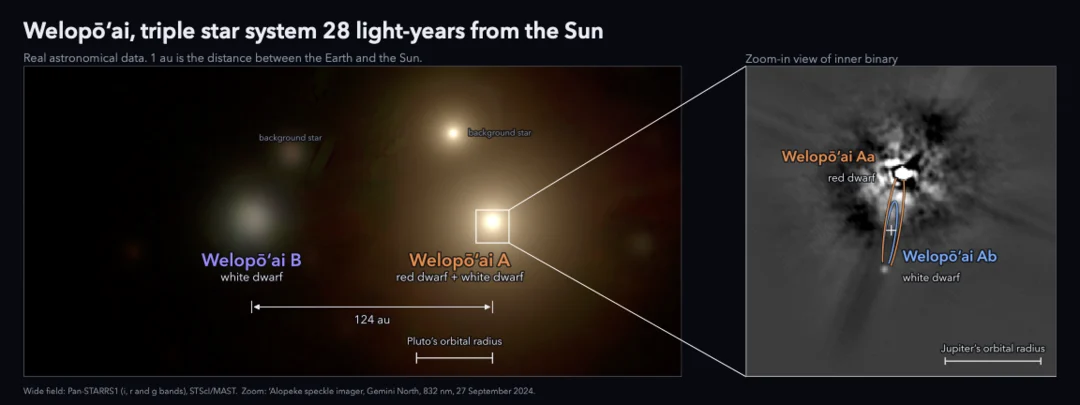
Pan-STARRS1 shows the widely separated components, and Gemini North resolves detail in the close pair.
Source summary
Astronomers looking for planets instead uncovered a close white dwarf orbiting a red dwarf in Welopōʻai, about 28 light-years away. A second white dwarf lies much farther out. Measuring the masses of the close pair gives researchers a way to test how stars lose mass and how multi-star systems survive that process.
What’s still open
The masses and orbits constrain how the system evolved. How its stars lost mass and how the system stayed bound are questions for models to test.