Can a network of pulsar clocks rule out giant black hole pairs at cosmic dawn?
Read the original source · Physical Review Letters · Search and limits
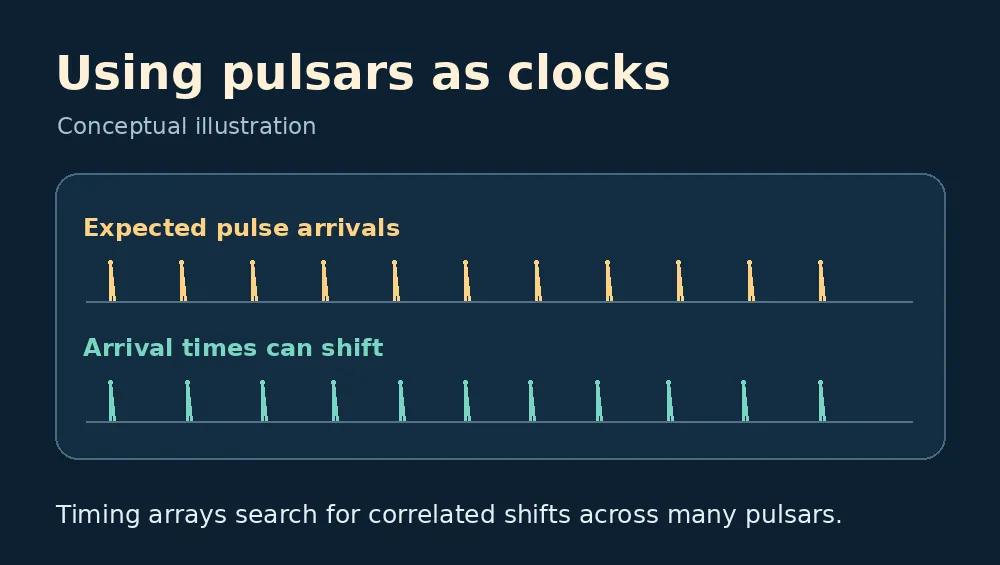
A conceptual illustration of timing shifts. The pulse positions are illustrative and do not represent the Parkes measurements.
Origin Question illustration based on the pulsar timing method
Source summary
Researchers accounted for cosmic redshift when searching Parkes pulsar timing data for quiet, persistent gravitational waves. In targeted searches toward two early-universe objects, they ruled out certain binary black holes with chirp masses above roughly ten billion Suns in the frequencies they tested. The result sets limits on how massive a pair could be without producing a detectable signal.
What’s still open
Binaries with lower masses or signals outside the frequencies searched remain possible.