Could a Webb little red dot candidate hold a growing black hole 450 million years after the Big Bang?
Read the original source · University of Tokyo · Spectroscopy and research summary
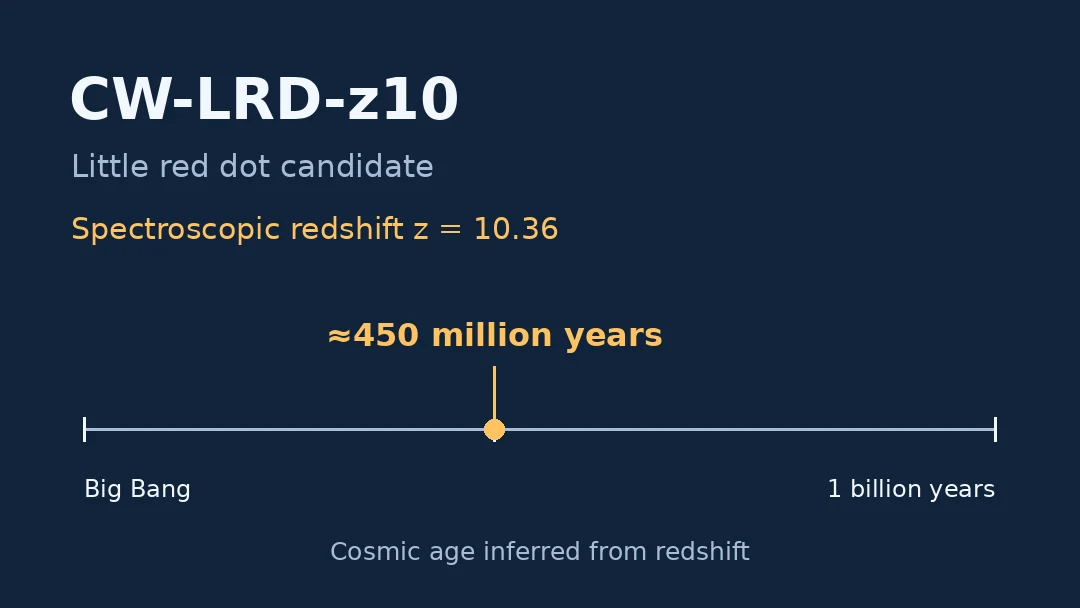
An original timeline marks the cosmic age inferred for CW-LRD-z10 from its reported spectroscopic redshift.
Origin Question graphic using University of Tokyo report data
Source summary
Webb spectroscopy measured a redshift of 10.36 for CW-LRD-z10, placing it about 450 million years after the Big Bang. It is the most distant strong little red dot candidate with a spectroscopic redshift in the team’s report. The color and compact appearance make it a target for studying early black hole growth. The redshift fixes its place in cosmic history, while the nature of its light source remains uncertain.
What’s still open
Spectroscopy establishes the distance, while the nature of the compact light source remains uncertain.