Euclid’s most distant confirmed quasar pushes the record back 40 million years
Read the original source · Max Planck Institute for Astronomy · Discovery report
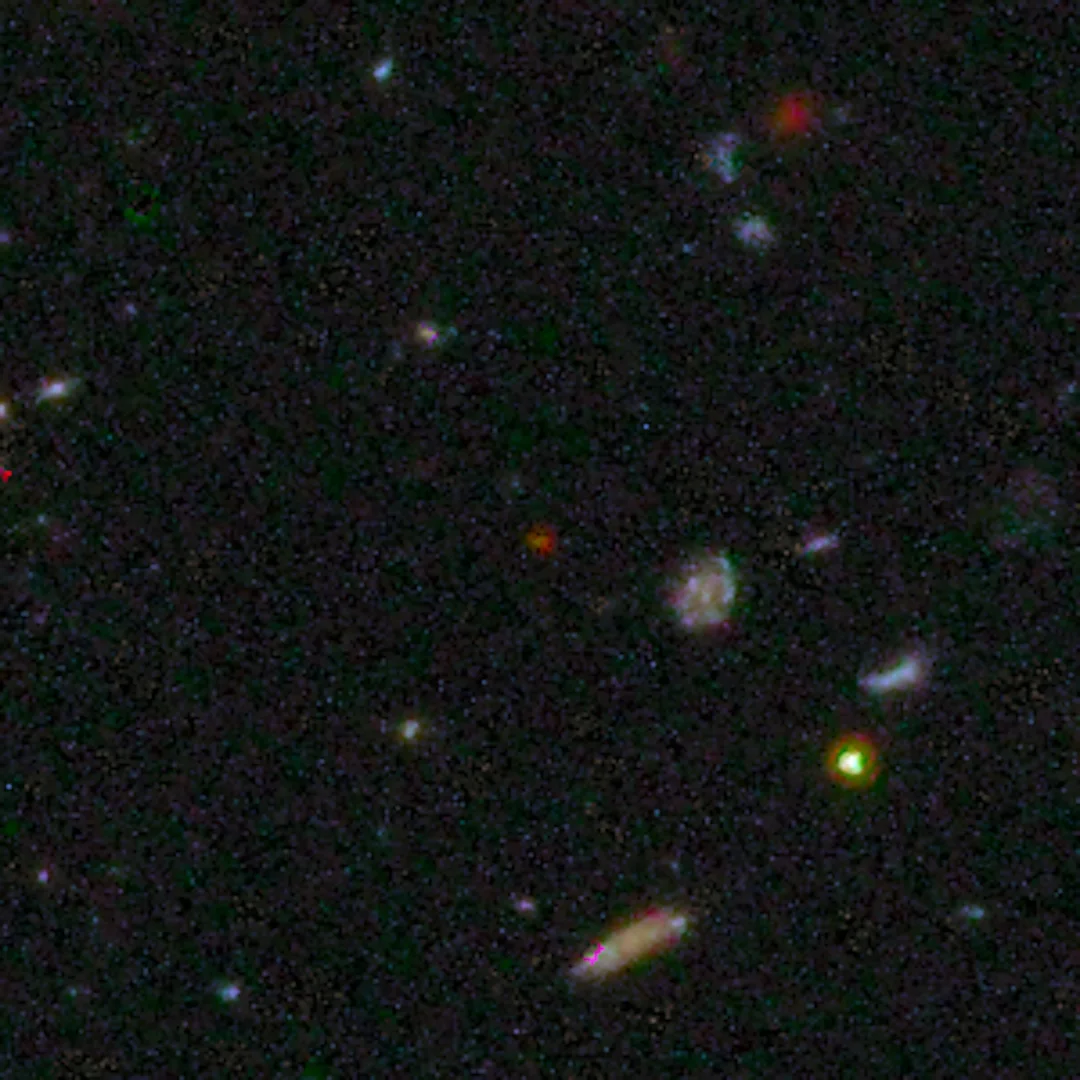
The red point at the center is J1504+6252 in a color composite from Euclid’s Wide Survey.
ESA/Euclid/Euclid Consortium/NASA, Wolf et al. (resized) · License
Source summary
The Euclid survey picked out J1504+6252, and follow-up spectroscopy measured a redshift of 8.13. We see the quasar about 630 million years after the Big Bang, when its central black hole already had an estimated mass of 360 million Suns. Models with massive starting seeds can explain this rapid growth, though the observations do not trace how this black hole formed.
What’s still open
The observations constrain the black hole’s age and mass, while its initial seed and growth history remain uncertain.