Could Dendra’s armour withstand a long day of combat?
Read the original source · Flouris et al. (2024) · PLOS ONE
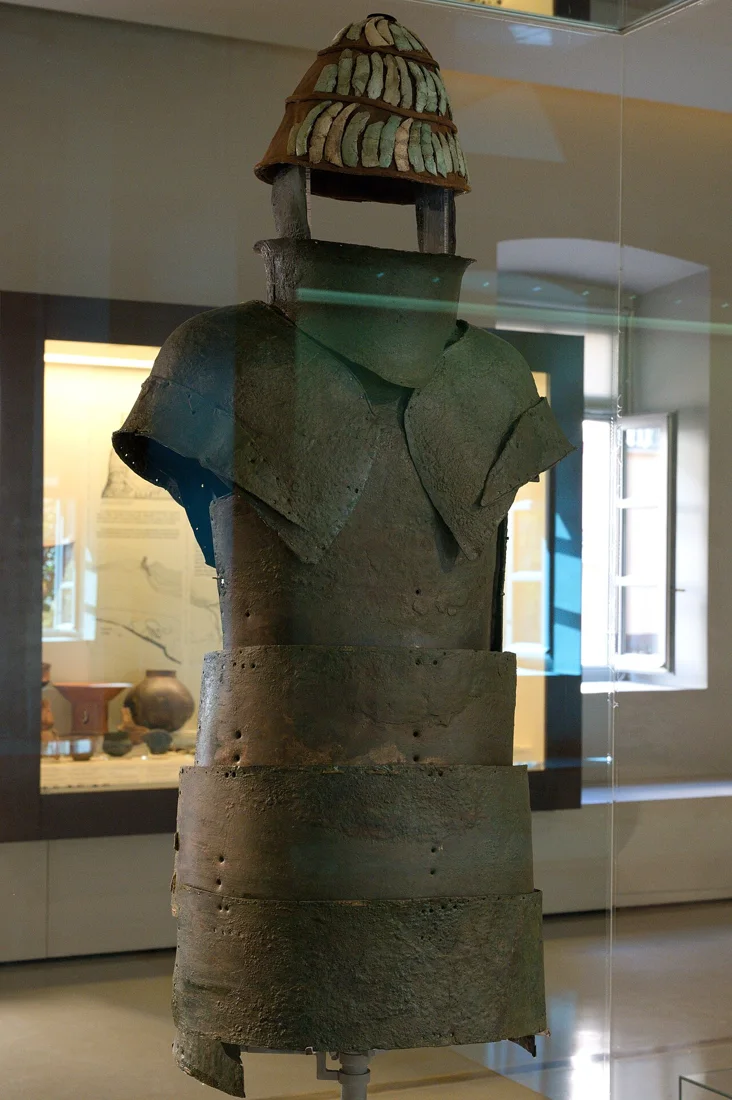
The original Dendra bronze armour at the Archaeological Museum of Nafplio, displayed with a reconstructed boar’s tusk helmet. The experiment used a modern replica.
What we know
All 13 Greek marines finished an 11-hour simulated day wearing a replica of the Bronze Age Dendra armour. The trial supports its practical use under the conditions tested.
What the researchers tested
The bronze suit, excavated from a tomb near Dendra in southern Greece in 1960, is about 3,500 years old. The team asked whether an elite fighter could move and work in it over a long day. Flouris and colleagues studied the archaeology and used Homer’s Iliad as one input to build a controlled day of simulated activity. The 11 hours included alternating periods of exertion and recovery.
What the experiment found
The 13 volunteers were male marines who practiced in advance. All finished the protocol, but reported fatigue, soreness and foot pain. The paper reports core temperatures between 36.4 and 37.7 °C and heart rates of up to 166 beats per minute. Grip strength, reaction time and the study’s hydration measure showed no statistically significant change across the day. The team also used a heat-transfer model to explore how conditions and effort could affect the results.
What the trial can establish
Completing the trial shows that wearing a replica over a long, demanding day was feasible for these trained people. This counters the idea that the suit was too cumbersome for extended use. Modern volunteers, replica construction and the safety limits of a simulation all shape that conclusion. Establishing whether this particular suit saw combat would require evidence tied to the artifact itself. The study also leaves open how common the armour was and how much it mattered to Mycenaean military success.