A dead star drives a shock wave without an obvious engine
Read the original source · ESO · Research release
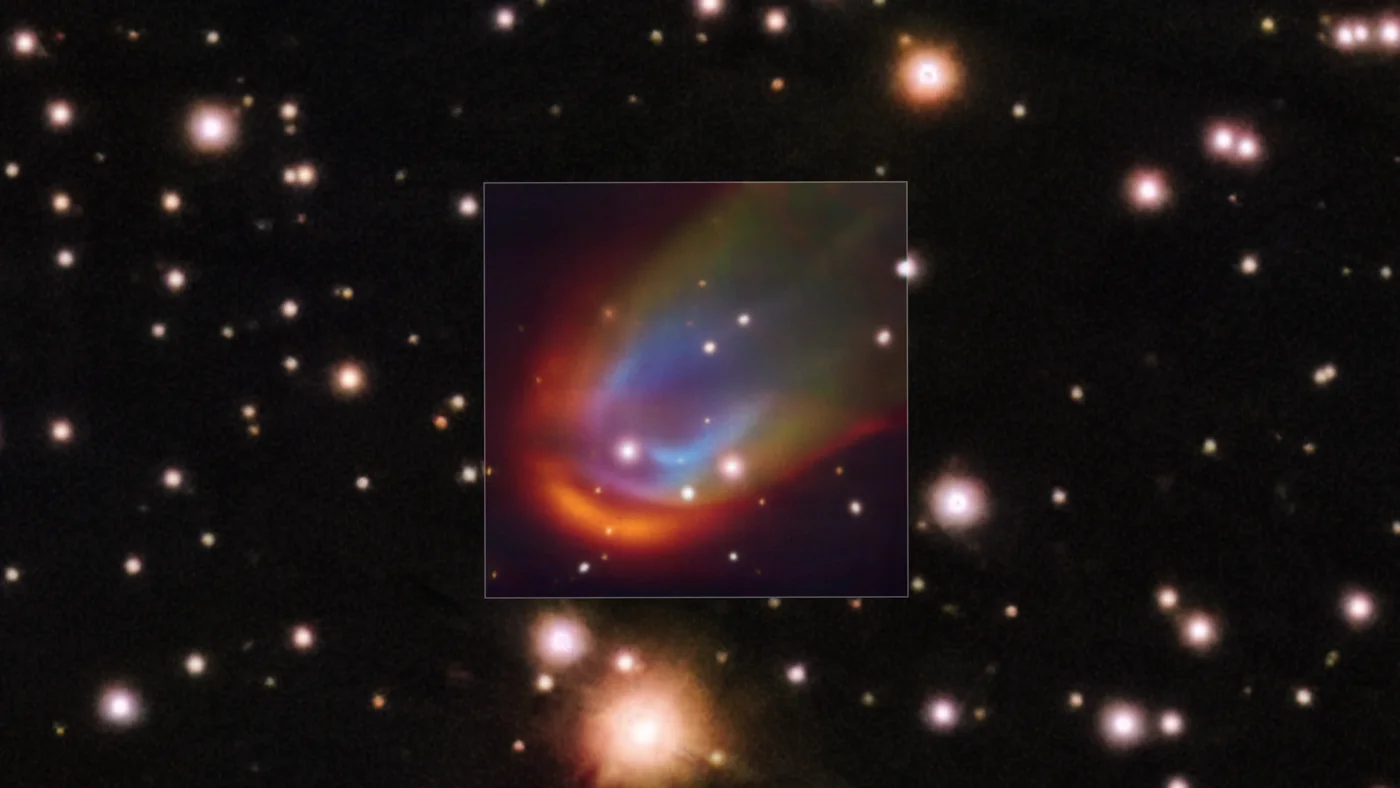
MUSE observations show the bow shock around RXJ0528+2838; the colors trace hydrogen, nitrogen and oxygen.
ESO/K. Iłkiewicz and S. Scaringi et al. Background: PanSTARRS (resized) · License
Source summary
Very Large Telescope observations mapped a bow shock around the white dwarf binary RXJ0528+2838. Its size suggests an outflow lasting at least a thousand years, although the system lacks the accretion disc usually associated with such flows. A magnetic field could supply energy, but the measured field does not yet explain the whole structure.